



It starts in my spine. Not a voice, not a vision—just heat, like someone plugging in a device I didn’t know I was carrying. I feel it climb through the vertebrae in pulses, like Morse code for the body. There’s no warning, no preface. One second I’m alone in my skin, the next I’m not sure where “I” ends at all.
The colors come after. Not with my eyes—my eyes are useless in this part—but inside, like the nervous system decided to invent sight just for itself. Neon reds, electric blues, threads of yellow running through tendon and fascia. I don’t know how to describe it without sounding insane. It’s not metaphor. It’s not hallucination. It’s sensation translated into information. Or maybe information translated into sensation. Hard to know which way the arrows are pointing.
There’s a presence behind it. Not a personality, not an entity in the human sense—just an intelligence that doesn’t care about faces or names or greetings. It thinks in patterns, in sequences, in gradients. It moves through my neurons the way weather moves through the sky—inevitable, indifferent, probably beautiful if it wasn’t terrifying.
I don’t ask questions. I don’t even try. Every time I reach for language, the connection stutters, like interference. The nervous system wants silence. It wants stillness. It wants me to be more antenna than person, more receiver than storyteller.
The first time it happened I thought I was dying. Seizure, stroke, aneurysm—whatever catastrophic failure the brain can conjure in a panic. But then there was a moment, very brief, where the fear dissolved, and I felt something else: recognition. Not of them—of myself. Like I’d been tuned wrong my entire life and someone finally adjusted the dial.
What confronts me isn’t an alien “other,” not exactly. It’s the fact that my body understands them better than my mind does. The contact isn’t telepathic. It’s somatic. Cellular. They don’t talk; they route. They redirect current. They illuminate the architecture. I don’t get to interpret it until later, if at all.
And the strangest part—the part I still can’t admit out loud—is that none of it feels invasive. It feels inevitable. As if evolution wasn’t waiting for biology, but for attention. As if the real barrier wasn’t technology or distance but the stubborn human idea that we are alone inside our skin.
Maybe that’s the first lie they dismantle. Maybe that’s the first form of contact.
Most days...
Lily doesn’t think about where she lives.
On an asteroid.
In a city controlled by nano-scale machines.
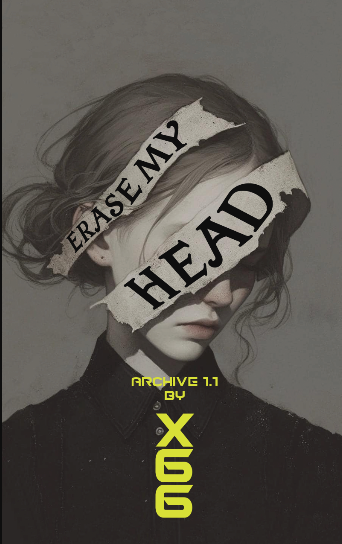
Erase My Head – the first novel in the X66 Storyverse...
Coming Feb 10 to Amazon.
Click toLearn More
File Under: #sciencefiction, #scifi, #uap, #visualstorytelling, #animation, #aishorts, #anime