I have watched worlds end without blinking.
Their lights bloom, dim, and vanish across threads of time like sparks pulled thin by wind. I do not mourn; I am witness. A reader of the real. The pattern speaks, and I listen.
But her thread resists the pattern.
From above, the brown dwarf’s rust-dark glow presses across the broken system like a bruise that never heals. Its light is heavy, old. Below, an asteroid tumbles, and in its crater—stitched to vacuous stone by machinery older than memory—a city clings and coughs and tries to remember how to be alive. I see the nanites—intelligent machines as small as amino acids, restless in a loop of creation and control, a repetition that has forgotten it repeats.
And there, within an apartment gutted by rain and years, Lily’s life trembles. She is small against the machine that made her, yet there is a wrong-note insistence to her pulse. It moves across the pattern like a ripple that refuses to flatten.
I am a cold white point against her sky. I do not touch. I do not speak. Not yet. I watch her fall through a dream of the city, a vision the machine whispers into her to keep her docile, to keep her turning. Still—her thread flickers, and the pattern feels it.
For now, I am only a witness. For now.
Darkness.
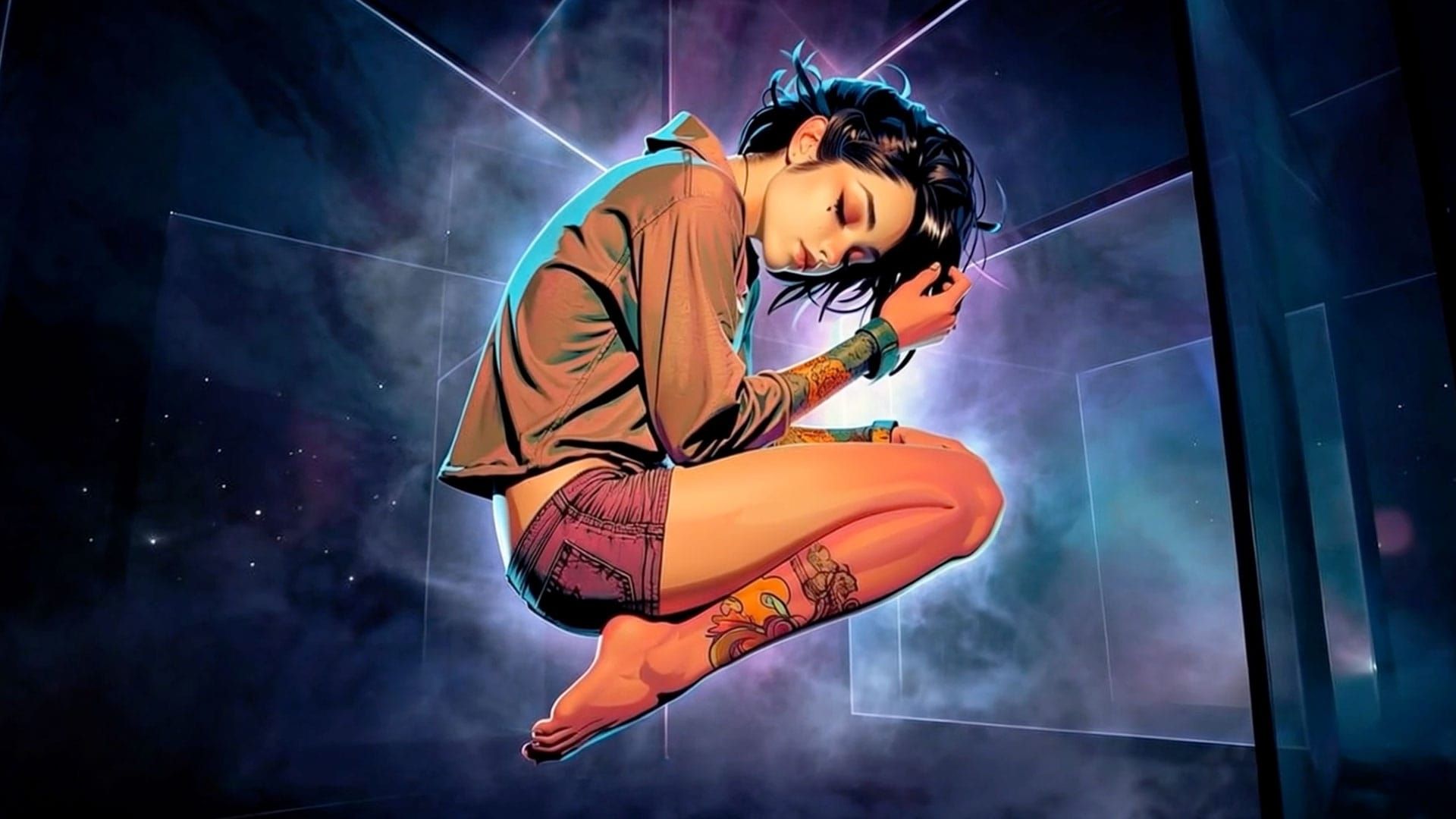
For a moment, there was nothing but the sound of Lily’s own breathing—fast, shallow, ragged—and the feeling of weightlessness. Then came light: a faint, silvery pulse flickering across her closed eyelids, like the memory of lightning. She opened her eyes and the void resolved into motion.
A head tumbled through space.
Her head.
A head tumbled through space.
Wind clawed at her hair though there was no air here, no atmosphere, only the drifting fragments of memory. Black VR goggles framed her face, their polished lenses reflecting a cold, impossible starlight. Lily didn’t understand how she could see herself from this distance. The image was at once familiar and alien, as if she were both observer and observed.
Somewhere beyond her perception, something watched. Not a voice, not even a thought—just a pressure on the edges of her mind, like the echo of a dream she couldn’t remember. A hush threaded through the silence, almost a word, almost not: “awake.”
The stars began to move.
A speck appeared in the infinite dark, spinning toward her. At first it seemed no larger than a grain of dust caught in a sunbeam. Then it grew, gathering shape and menace. A lumpy, cratered surface emerged—an asteroid, tumbling end over end, its contours shifting as if unsure whether it was natural or engineered. Its approach felt inevitable, almost sentient, like a predator circling prey.
Lily tried to look away, but there was nowhere to look. The blackness went on forever.
The asteroid loomed closer. Closer still. Its surface filled her vision, until she could see individual shards of rock and twisted metallic veins glinting beneath a film of frost. Her breath caught. It was beautiful, in the way a corpse could be beautiful—a frozen relic of some ancient catastrophe.
And there, nestled inside its deepest crater, lay a city like a secret folded into stone and draped beneath a heavy atmospheric haze.
At first glance it resembled a war-torn European capital: soot-stained brick buildings, narrow streets, bombed-out plazas. Chimneys rose like broken teeth against a sky the color of cold. Smoke curled upward in frail, uncertain ribbons, swallowed by dark clouds churning with silent violence. Windows gaped like empty sockets. Nothing moved.
The asteroid’s jagged rim formed a natural wall around this strange settlement, reminding Lily of a snow globe tipped on its side, ready to shatter. Massive atmospheric generators clung to the cliffs like beetles. Far above, a brown dwarf pressed a low, rusted light into everything—as if the universe had forgotten daylight. At the rim of that ruin-sky, another glint hung still: a white point of light she’d never noticed before, too steady to be a star. She blinked, and it seemed to dim. “Remember,” the hush threaded again, so faint she could have imagined it.
The wind—or the illusion of wind—howled in her ears.
Her heart pounded. She was falling, though she couldn’t feel her body.
A flicker of static tore across her vision. Then another.
The image of the city stuttered and warped, replaced for an instant by a full-color flash of her own face, mouth open in silent terror, hair matted with dust and ash. She saw her lips move as if speaking, though she couldn’t hear the words. Something about the way her jaw worked felt like a warning from a future she didn’t own.
And then the image was gone, replaced once more by the cratered city, silent and still.
Something inside her whispered that none of this was real.
Another part of her—the part that still remembered the smell of smoking streets and the shriek of sirens—insisted it was.
As she tumbled closer, the buildings sharpened into focus. One structure rose above the others: a dilapidated apartment block with a jagged hole ripped through its roof. Her building. The one place she still called hers.
Lily’s throat constricted. She wanted to scream but couldn’t.
The final flicker of static erased her face entirely, leaving only darkness.
When light returned, she was seated in her chair inside the cramped apartment, VR goggles pressed to her face, hands gripping the armrests like lifelines. Her body trembled as though she’d been falling for hours. The faint hum of her own breath filled the silence. For a moment she couldn’t remember where the dream ended and the waking world began.
Behind the goggles, a voice—soft, almost loving—murmured in her mind, “keep going. Keep fighting. The mission isn’t over yet.” The murmur braided with the earlier hush till it felt like one thread tugging through her skull, “awake… more than this…”
The link has been copied!