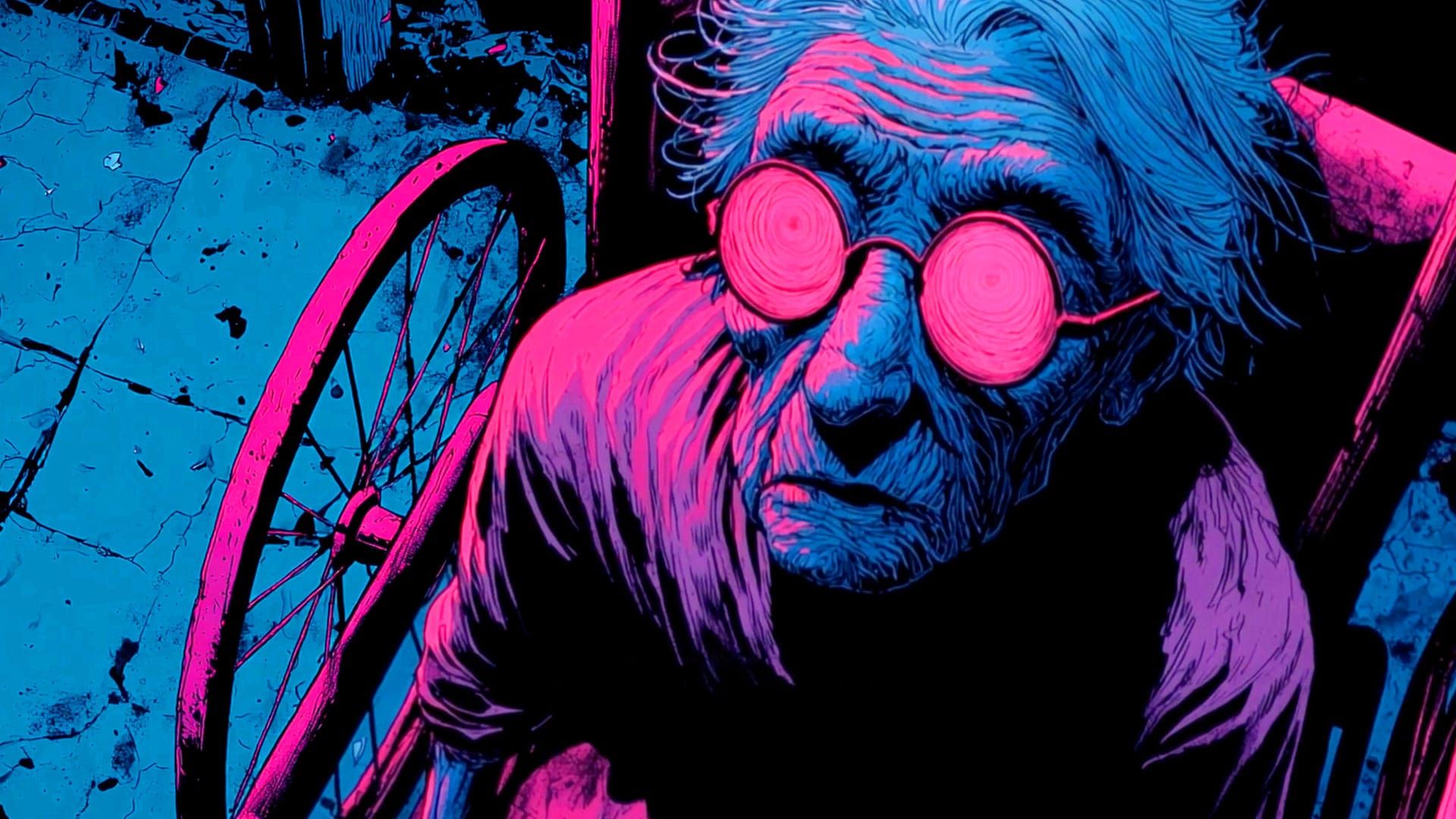
The sky was the first thing that struck her: a swirling bruise of purple and black, shot through with veins of lightning. It pressed low over the city, heavy with static and ash. Beyond the crater’s jagged rim, Lily could just make out the vague silhouettes of neighboring asteroids, silent and watchful, like predators waiting for a weakling to fall behind.
The streets were nearly empty. A few figures huddled in doorways, their skin the color of wax, eyes dull and unfocused. The “living dead,” Lily thought bitterly — husks who’d given up resisting, content to rot beneath the State’s boot.
Their heads turned slightly as she passed, but no words left their lips. Just the faint hiss of breath and the soft clicking of their teeth.
She walked faster.
The fungus was everywhere here, sprouting between cobblestones, weaving up lampposts, trailing from shattered balconies. In some places it formed intricate repeating symbols, almost like writing — curves within curves, like someone trying to communicate in a language too alien to decipher.
Lily didn’t look too closely. The resistance claimed it was part of the regime’s control system — a chemical hallucinogen released into the air to keep people docile. She didn’t know if that was true, but she couldn’t deny its effect.
Sometimes, when the spores were thick, the city itself seemed to shift: buildings leaning where they hadn’t before, streets rearranging themselves like puzzle pieces. And sometimes, just at the edge of her vision, she saw faces in the fungal blooms, watching her with blank white eyes. When she blinked, they were gone, leaving only pulsing black rot.
She told herself those were hallucinations.
She told herself a lot of things.
Lily was thinking of food and plotting her path to the closest bodega when she heard the sound of a van navigating the upturned street. The engine clunked as the tires wheezed against the damp cobblestones. The sound of it sent chills up her spine and she froze. The van itself seemed somehow alive, its rusted panels fused with omnipresent fungus that pulsed faintly beneath its corroded skin.
From a side alley, three drones glided into view. She recognized them at once by the glint of their inhuman face goggles, flashing red. Their angular frames bristled with jointed arms and surgical pincers. Their motion was disturbingly smooth, silent save for the faint hiss of hydraulics.
One drone extended a limb, clamping onto a husk’s shoulder with mechanical indifference. The body twitched once — then went slack as the drone hoisted it effortlessly and slid it into a waiting cart. Another husk was seized, then another, the heap of lifeless forms growing like garbage awaiting collection.
Lily’s pulse thundered in her ears. She ducked behind a shattered wall, forcing herself not to breathe.
These weren’t just machines. They were collaborators, built to carry out the will of the State’s AI loop, soulless enforcers ensuring the cycle continued.
She’d heard the rumors whispered in dark corners: rebels and civilians alike taken in the night, carted off to underground chambers where screams never stopped. Torture. Experiments. Disposal. The State made people vanish, and the drones were the instruments of that terror.
She clenched her fists, rage burning beneath her fear. Her nails dug crescents into her palms until she nearly broke the skin. She welcomed the pain — proof she was still alive, still fighting. Someday, she would destroy them. Someday, vengeance would come for those “poor souls.”
The link has been copied!