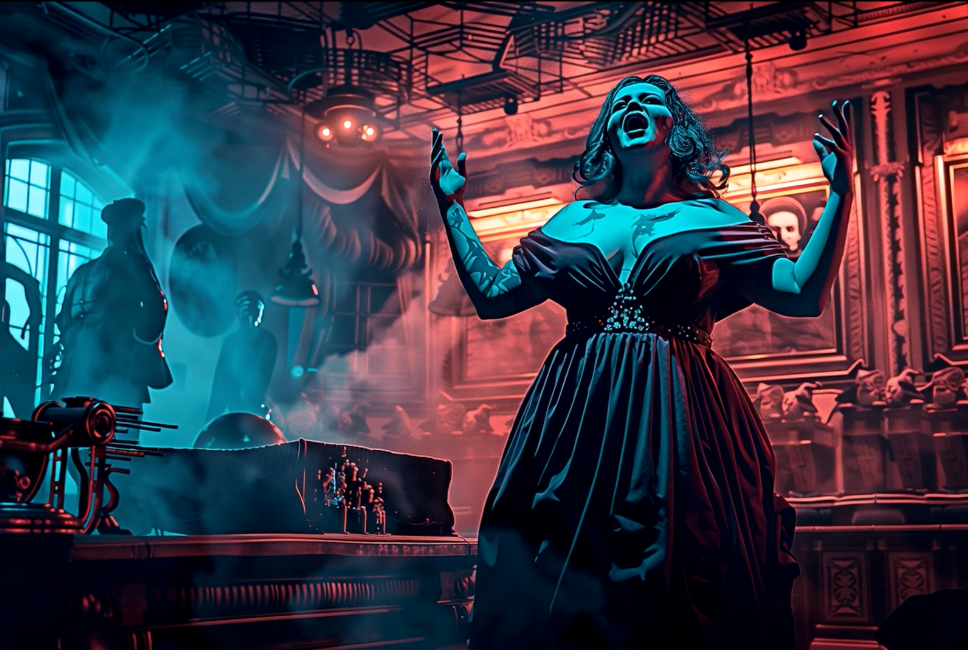
As Hala began to sing, the room settled into coherence. Her voice filled the space without strain, low and commanding, textured with age and indulgence. The acoustics embraced her. The audience leaned forward as one organism.
By the time Hala Tujmik took the stage, the audience was already primed to adore her.
The theater had been rebuilt three times atop its own ruins, each iteration preserving the illusion of continuity. Gilded balconies. Red velvet worn thin at the edges. Gaslight fixtures wired to modern power but kept dim on purpose. Early twentieth-century Paris, filtered through memory and money.
Hala loved it.
She emerged slowly, deliberately, magnificent in the way only a woman past apology could be. Heavyset, radiant, draped in layered silk that caught the light like planetary rings. Her presence bent the room—not through force, but mass. Jovian. Unavoidable.
Applause swelled before she lifted a hand.
Hala acknowledged it with a smile that was both effusive and exact. She gave the audience warmth, but not intimacy. Intimacy was expensive. Reputation required distance.
From the wings, Harlan Bow watched her with professional calm.
He had been her agent since before the circuits collapsed, since before nationality became aesthetic rather than fact. He knew how carefully Hala curated her myth: Russian, insofar as that still meant severity, endurance, gravity. The last great voice of a place erased centuries ago, resurrected through sound.
The program was conservative by design. No surprises. No political gestures. This was a stabilizing performance—sanctioned, subsidized, attended by cultural ministers and corporate patrons who believed art should reassure.
Harlan liked it that way.
As Hala began to sing, the room settled into coherence. Her voice filled the space without strain, low and commanding, textured with age and indulgence. The acoustics embraced her. The audience leaned forward as one organism.
0:00
/0:12
Midway through the second movement, Harlan noticed the silence.
Not the musical silence—Hala was holding a pause perfectly—but the audience’s collective breath failing to return on cue. The timing slipped. The rhythm of listening fractured.
Someone screamed.
The sound was cut short.
A single report echoed from the upper balcony—flat, precise, intimate. Not meant for Hala. Meant for the man seated three rows behind the cultural attaché from the southern districts.
The assassination was surgical.
The reaction was not.
Panic erupted in waves. Bodies surged. Chairs overturned. Security drones descended too late to matter. Somewhere backstage, alarms began arguing with one another.
Harlan turned toward the stage.
Hala was still singing.
Her voice did not falter. She did not look toward the audience. She did not acknowledge the rupture. She sang through the chaos as if completing a ritual older than consequence.
For one astonishing minute, the theater obeyed her instead of fear.
Then the spell broke.
Harlan was already moving when she finished—guiding her offstage, past shaking technicians and shouting officials. Hala’s breathing was controlled. Her expression unreadable.
“Was it us?” she asked quietly.
“No,” Harlan said. “Anarchists. Rival cell. They’ll blame the Resistance.”
She nodded once. Calculating. Protective.
“Good,” she said. “Then it remains someone else’s story.”
Later, footage of the performance circulated endlessly—Hala’s voice soaring over screams, her stillness framed against panic. Commentators debated whether it was courage or complicity.
Hala declined interviews.
The theater was closed for renovations.
And somewhere in the city, someone watched the recording and understood that art did not stop violence—
It taught it how to wait.
Most days...
Lily doesn’t think about where she lives.
On an asteroid.
In a city controlled by nano-scale machines.
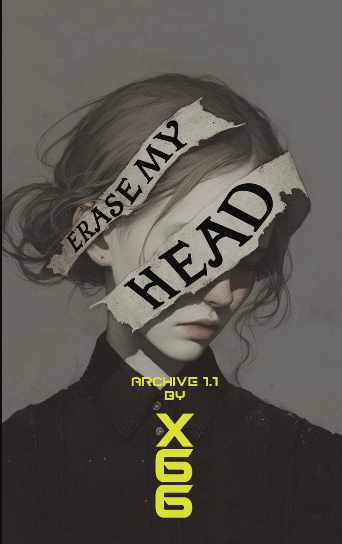
Erase My Head – the first novel in the X66 Storyverse...