



(Recovered peripheral fiction · pre-EMH)
The transit concourse was crowded in the way crowds always are when no one wants to be at home.
Lily sat on the low concrete lip beside a vending kiosk that sold expired sweets and nicotine substitutes. Her friends talked over one another—complaints, rumors, recycled jokes. Above them, an advertisement panel cycled through sanctioned images: clean apartments, smiling couples, children framed in artificial sunlight.
STABILITY IS KINDNESS.
The panel flickered.
Just once.
Lily noticed because she always noticed small things—timing errors, mismatched seams, the way the city sometimes seemed to breathe when it thought no one was paying attention.
The flicker wasn’t dramatic. No sparks. No alarms. The image froze mid-smile, the slogan stretching into a pale smear.
Then the wall behind the kiosk shifted.
Not collapsing. Not cracking.
Sliding—less than an inch, but wrong. The seam where wall met ceiling misaligned, as if the geometry had briefly reconsidered itself.
Lily felt it before she fully saw it: a pressure behind her eyes, a low vibration under the noise of the station. Like a note being held just below hearing.
Conversation around her faltered, then resumed. No one screamed. No one pointed.
A child laughed.
The wall corrected itself. The advertisement resumed its cycle. The city smoothed the error over and moved on.
Lily stood.
She crossed the few steps to the wall and placed her palm against the concrete. Cold. Damp. Ordinary—except for the faint residual hum that faded as she focused on it.
One of her friends asked if she was okay. Lily nodded, because that was easier than explaining what she didn’t yet have language for.
They left soon after. No one wanted to linger underground when the air felt thin.
That night, Lily dreamed of corridors that didn’t belong to any building she knew. Walls without seams. Doors that weren’t doors so much as permissions. She woke with a metallic taste in her mouth and the sense that something had paused too close to her.
In the morning, she found the mark.
It was etched into the concrete outside her apartment door—shallow, precise, unfinished. Not graffiti. Not a symbol. The longer she looked at it, the harder it was to remember its exact shape.
Beside it lay a small metal disc, coin-sized and warm.
Lily stood barefoot in the hallway for a long time before picking it up. It fit her palm too well. The warmth wasn’t heat—it was activity, like something idling.
She brought it inside. Locked the door. Told herself she’d throw it away.
She didn’t.
Over the next two days, the disc stayed warm. The mark outside her door didn’t fade. Public audio glitched once at midday, replacing its usual announcement with a single sustained tone that made people stop walking without knowing why.
Seven seconds.
Then normality reasserted itself.
On the third day, Lily felt it again—the pause.
She was crossing the main concourse when the crowd briefly lost its rhythm. People continued moving, but not together. Like frames slipping out of sync.
That’s when she saw him.
He stood motionless near one of the old marble columns, hands folded neatly over the head of an elegant cane. Elderly. Wealthy. Wool suit cut just slightly out of fashion, scarf arranged with deliberate care. He did not belong to the station, and yet he fit into it perfectly—too subtle to notice, too strange to ignore.
The crowd flowed between them.
People passed directly in front of him without reacting. A courier clipped his shoulder and didn’t look back. A woman brushed past his cane as if it weren’t there.
The man’s face was unreadable. Not blank—unstable. Features resolving, then slipping, like an image struggling to buffer. His eyes remained fixed on Lily.
She stopped walking.
Her heart began to race—not with fear, but with the certainty that whatever this was, it had already decided she could see it.
You noticed the wall, a voice said.
It did not come from the man’s mouth.
It came from inside her head, calm and unhurried, threaded through her own thoughts like it had always been there.
I didn’t imagine it, Lily thought, not realizing she was answering.
No, the voice replied. You recognized it.
The disc in her pocket pulsed—slow, warm, patient.
The man did not move. Did not blink. His image jittered at the edges, momentarily overlaid by passing bodies, as if he were being composited imperfectly into the scene.
We don’t recruit, the voice continued. We find the ones who can’t unsee the correction.
Who are you? Lily thought.
A pause—not hesitation, but calibration.
That isn’t the right question yet.
The station’s audio system crackled. Somewhere above them, an announcement began and immediately cut itself off.
You don’t have to do anything, the voice said. Just don’t lie to yourself about what you saw.
The crowd surged.
For half a second, someone passed directly in front of the man—and when they cleared, he was gone. No displacement. No exit. Just absence, like a detail removed from a picture.
The station’s rhythm reasserted itself. Footsteps synchronized. Voices overlapped properly. The world repaired its own continuity.
Lily stood alone, breath shallow, fingers curled inside her coat pocket around the warm disc.
Around her, no one noticed anything missing.
The walls stayed still.
For now.
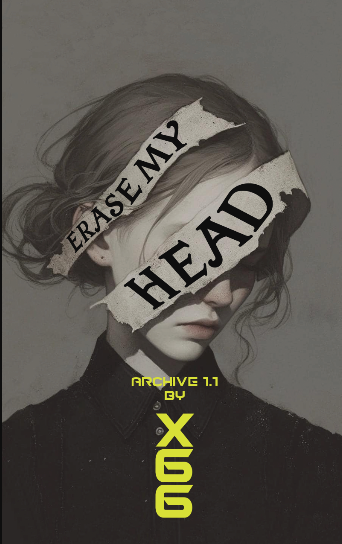
Most days...
Lily doesn’t think about where she lives.
On an asteroid.
In a city controlled by nano-scale machines.
Erase My Head – the first novel in the X66 Storyverse...
Available Now at Amazon.
Click toLearn More
File Under: #sciencefiction, #scifi, #uap, #visualstorytelling, #animation, #aishorts, #anime