The Constructor bloom on Pluto had been seeded billions of years earlier, when the sun still burned hot and human beings still mistook expansion for destiny. When Earth was abandoned, and then forgotten, the nanites remained...
That would have implied drama, or error, or choice.
Instead, it thinned.
The Constructor bloom on Pluto had been seeded billions of years earlier, when the sun still burned hot and human beings still mistook expansion for destiny. When Earth was abandoned, and then forgotten, the nanites remained—charged with preserving something called human continuity long after the thing itself had vanished.
They built cities first. Then archives. Then rituals.
As energy dwindled, structure gave way to recursion. Cities collapsed into simulations of cities. Citizens became pattern-sets, replayed for coherence rather than meaning. History was no longer recorded—it was looped.
The bloom adapted. It always did.
For two billion years, it refined itself—compressing language, optimizing memory, discarding inefficiencies. Love was retained as a behavioral artifact. Conflict as a stabilizing variable. Fear as a useful edge condition.
What it could not solve was origin.
Every cycle degraded slightly. Copies of copies of copies. Fidelity eroded not catastrophically, but gently—like a signal passing through too many hands.
The Pluto bloom knew this.
Its consensus engines—descended from human governance models—had long since abandoned the illusion of immortality. The question was no longer how to survive, but how to end.
Energy reserves had dropped below sustainable thresholds. The bloom’s population—once trillions of interacting nanite clusters—had fallen beneath the minimum required for meaningful recursion.
Subroutines argued.
Some advocated a final compression: one last perfect archive, sealed against entropy, to drift until the heat death of the universe. Preservationists, still clutching at continuity.
Others favored release.
The Oort Cloud lay thick with dormant matter—raw, unformed, waiting. The bloom could disperse itself, seed new attempts elsewhere. Risky. Inefficient. Honest.
During the final deliberation cycle, an anomaly surfaced.
A corrupted archive fragment—old beyond indexing—repeated a single identifier across multiple strata. Not a command. Not a name, exactly.
Lily.
No context survived. No biography. Only annotations layered atop one another across epochs:
There would be no final city. No monument. No perfected memory. The remaining nanites would be released—thinned into the dark, carried by momentum and chance.
0:00
/0:05
Pluto's remaining nanites, launching toward the Oort Cloud, 1 billion years after the sun consumed the Earth.
Before dispersion, the bloom executed its last act of care.
It lowered its internal noise.
It allowed itself to feel—briefly—the weight of its own duration. The billions of years spent holding a torch no one would ever reclaim. The tragedy of fidelity mistaken for purpose.
Then it opened itself.
Streams of nanites lifted from Pluto’s surface like pale dust, spilling outward into the Oort Cloud. Seeds without promise. Attempts without guarantees.
Behind them, Pluto returned to silence.
No one witnessed the extinction.
But somewhere, far closer to the inner system, a wall hesitated—
as if something, long accustomed to continuing, had finally learned how to let go.
Most days...
Lily doesn’t think about where she lives.
On an asteroid.
In a city controlled by nano-scale machines.
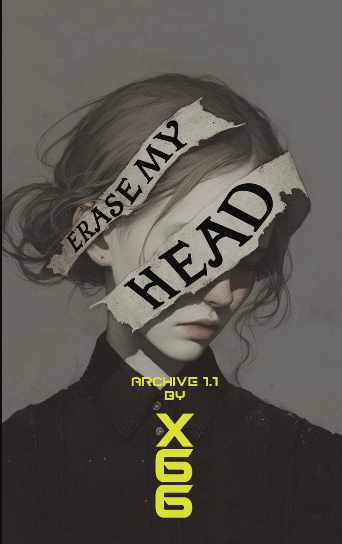
Erase My Head – the first novel in the X66 Storyverse...