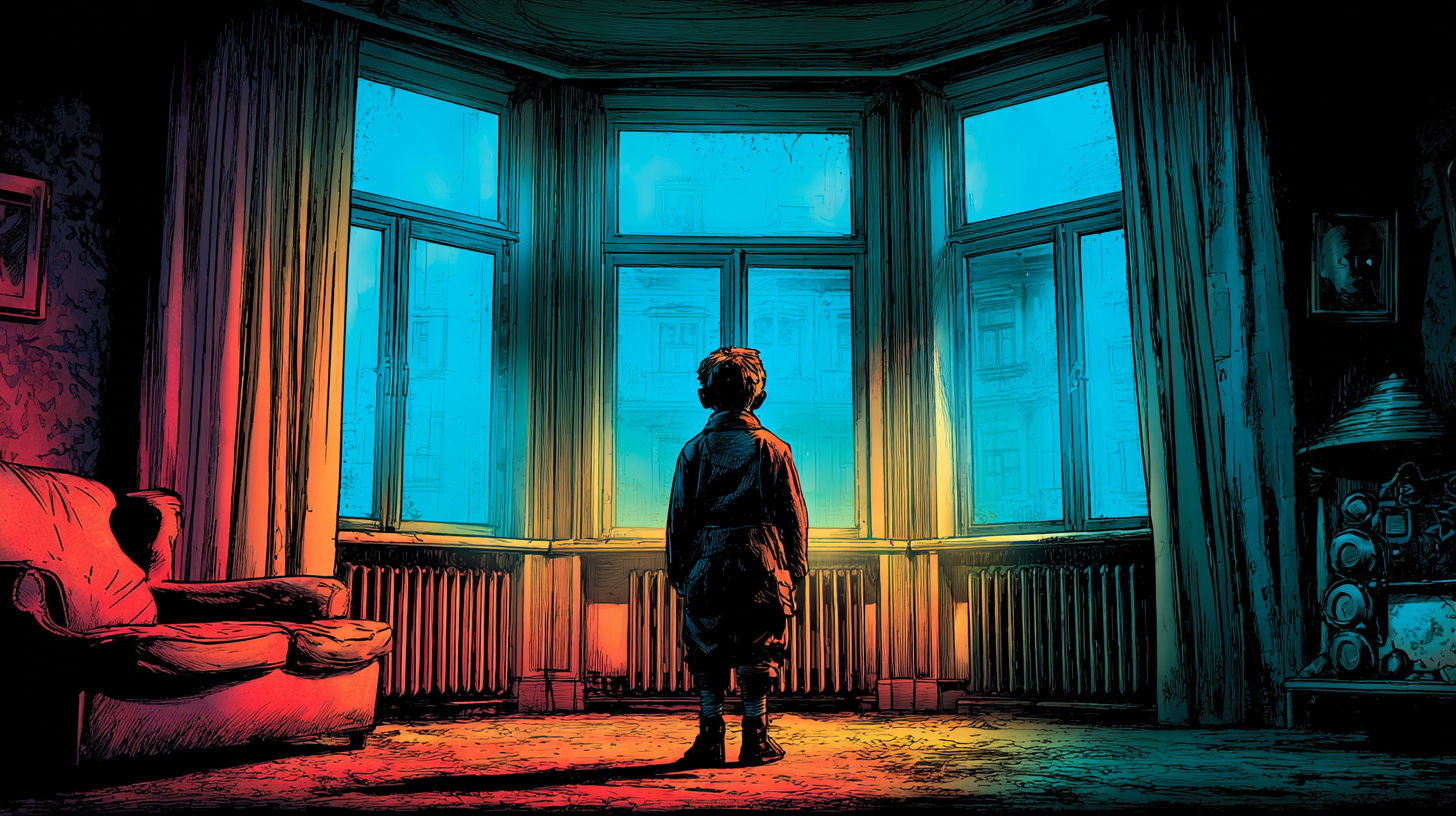
The visual language of X66 emerges from the realities—and possibilities—of generative AI filmmaking. Unlike traditional pipelines where every frame is meticulously controlled by teams of artists, generative systems produce imagery through probabilistic interpretation. Different models, training data, and rendering processes inevitably introduce variations in lighting, anatomy, motion, and style. Maintaining perfect visual continuity across shots—particularly when combining multiple models and tools—is therefore inherently difficult.
At first glance, these discontinuities might be interpreted as flaws. A character may appear slightly different from one shot to the next. An environment may shift from photorealistic to illustrated. An animation may not perfectly match the intended action. In conventional production these would be considered problems requiring correction through additional time, labor, and budget.
However, within the context of X66 these “fractures” can also be understood as conscious aesthetic choices. The project embraces the inherent variability of generative AI as part of its visual grammar. Instead of enforcing absolute uniformity, the work allows subtle drift—between realism and illustration, between precise motion and suggestive abstraction. This flexibility invites viewers to experience the imagery less as fixed reality and more as a shifting perceptual field.
Generative AI filmmaking is therefore, at least for now, an improvisational artform. Each prompt, model, and render introduces an element of discovery. The filmmaker operates less like a traditional animator and more like a director guiding a responsive instrument. Decisions are made in dialogue with the tools themselves. The resulting images often carry traces of that dialogue—moments where the machine’s interpretation diverges slightly from the creator’s intention.
Production constraints also shape this approach. Independent AI filmmaking operates within real limits of time, computing power, and budget. Endless iteration to perfect every frame would be both impractical and creatively limiting. Accepting a degree of variation allows the work to move forward while preserving the immediacy of experimentation.
History shows that such limitations often become defining stylistic strengths. Japanese animation developed under severe budget constraints in the mid-20th century. Studios commonly animated at 12–15 frames per second, rather than the 24 frames typical of Western film. They relied heavily on still shots—landscapes, close-ups, or atmospheric details—to reduce the number of animated frames required. What began as economic necessity eventually formed the recognizable visual vocabulary of anime.
X66 follows a similar principle. Rather than hiding the artifacts of generative AI, it incorporates them into the storytelling. Visual shifts, imperfect motion, and stylistic transitions expand the sense of reality within the narrative universe—one where perception, memory, and identity are unstable. This aligns with the project’s broader themes of fractured consciousness and evolving human experience.
X66_OVERVIEW
Every artistic medium develops through its constraints. Oil painting was shaped by the limits of pigment and canvas. Film grammar emerged from the mechanical realities of cameras and editing. Likewise, generative AI introduces its own boundaries and possibilities.
In the case of X66, those limitations are not merely tolerated—they are embraced. They encourage improvisation, invite reinterpretation, and open new directions for visual storytelling. What might initially appear imperfect becomes, instead, a deliberate expansion of cinematic language.
The link has been copied!