


(Recovered peripheral fiction · pre-EMH)
Everyone had a different version of how the Resistance worked.
Some people talked about cells. Others talked about layers. One guy insisted there was a central committee somewhere inland, protected by relic infrastructure and people who never slept. No one agreed on names. No one agreed on scale.
What they agreed on was this: instructions arrived when they arrived.
Lily learned this sitting with friends in half-lit rooms, drinking whatever passed for alcohol, arguing quietly about routes and timing and whether anyone was actually listening on the other end. The talk always circled the same question.
Who’s giving the orders?
No one had an answer that survived daylight.
Her turn came without ceremony.
She was handed a comm unit—old, cracked, unpowered—and told only where to go. No time. No contact name. Just a station marker scratched into paper.
The train took her farther than it should have.
Each stop after the fifth felt wrong—platforms skewed at odd angles, signage peeling away from meanings it no longer supported. The station she disembarked at looked like it had been abandoned mid-argument. Walls blackened by old fire. Tracks buckled. A train sat derailed at the far end, its windows blown out, metal folded inward like paper.
No people.
Lily followed the instructions as best she could. The comm unit stayed dark.
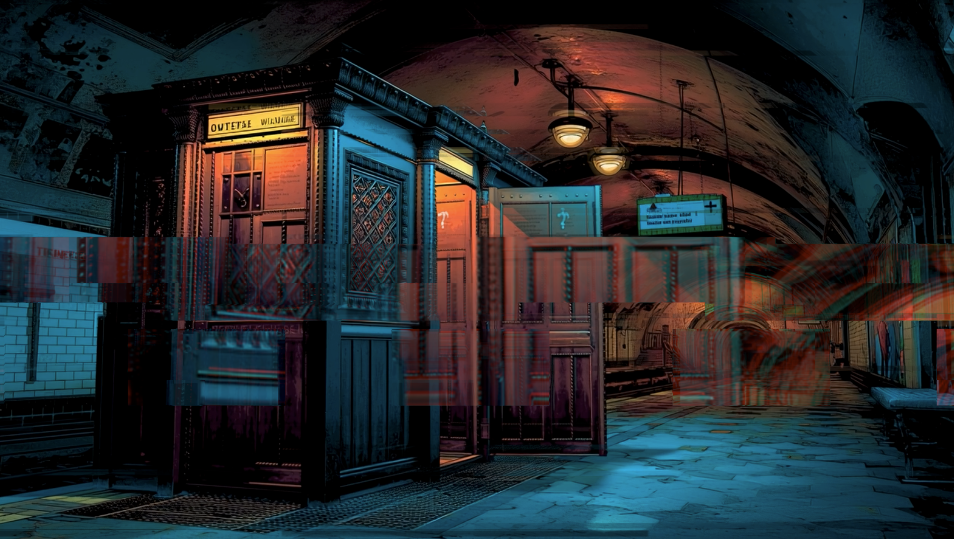
She turned left through a wall that should not have opened and found a stairwell descending into nothing particular. The air changed as she went down—cooler, heavier, as if the space had been sealed for a long time.
At the bottom, the platform widened.
And there it was.
A Catholic confessional booth, massive and dark, carved mahogany polished smooth by hands that no longer existed. It sat absurdly at the center of the platform, unmarked, intact, as if it had simply been placed there.
The derailed train loomed behind it like an accusation.
Lily stopped several feet away.
She waited.
Nothing happened.
She stepped closer and cleared her throat, feeling ridiculous. “Hello?” she said, softly.
No answer.
She leaned forward and looked through the lattice.
The booth was empty.
No priest. No chair disturbed. No sign of recent use. Just shadow and the faint smell of old wood.
Lily stood there longer than she meant to. Long enough to feel foolish. Long enough to feel watched anyway.
Something registered—not a voice, not a command. A location, fixed in her mind with quiet certainty.
This was it.
Not a meeting place. Not a person.
A site.
She backed away slowly.
On the ride back, the comm unit warmed in her hand for the first time.
When Lily later tried to explain it to the others, the words wouldn’t line up. Some laughed. Some nodded like they’d heard versions of the story before.
“Yeah,” someone said. “That sounds right.”
No one offered clarity.
No one pretended to know more than they did.
And from that point on, when instructions arrived—misprinted signs, wrong turns that turned out to be right—Lily understood something fundamental about the Resistance:
No one was leading.
They were moving.
And sometimes, movement was enough.
Most days...
Lily doesn’t think about where she lives.
On an asteroid.
In a city controlled by nano-scale machines.
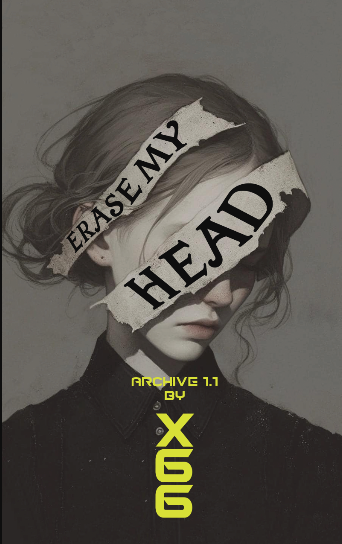
Erase My Head – the first novel in the X66 Storyverse...
Now Available on Amazon.
Click toLearn More
File Under: #sciencefiction, #scifi, #uap, #visualstorytelling, #animation, #aishorts, #anime